Why should the official heading of “social media responsibility” be defined in large companies?
Specialized Media Case; The Forgotten Social Responsibility of the Industry/21st Report
Deprecated: preg_split(): Passing null to parameter #3 ($limit) of type int is deprecated in /home/madanname/public_html/wp-content/themes/jannah/framework/functions/post-functions.php on line 800

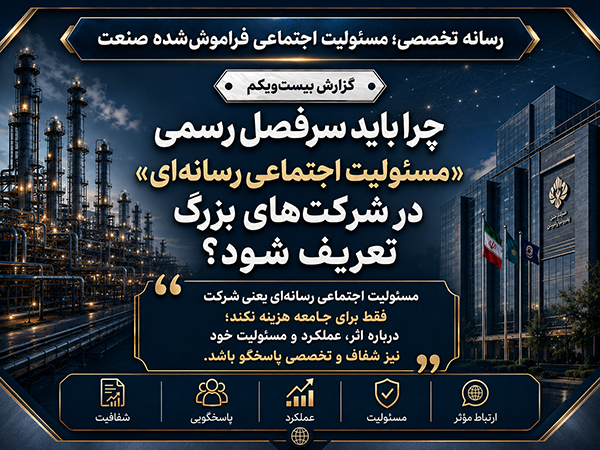
Chakameh Javaheri Aria_ ” Madan Nameh ” news site : Social media responsibility means that a company accepts that part of its responsibility to society and stakeholders is to provide accurate, transparent, specialized, and continuous information about its performance, impacts, projects, crises, and decisions. This concept does not mean advertising the company or buying media praise. It means accepting the fact that action without explanation, cost without reporting, and responsibility without accountability are incomplete.
In the mining and steel industries, this responsibility is even more important. The activities of these companies affect the regional economy, employment, environment, natural resources, energy consumption, capital markets, contractors, employees and industrial policy. Therefore, the company’s audience is not limited to customers or shareholders. The local community, government institutions, capital market actors, the media, employees, contractors and specialized public opinion also have the right to receive understandable and assessable information about the company’s performance.
Social media responsibility means that the company should not only implement projects in the community; it should also explain the impact of that project. It should not only make announcements in times of crisis; it should also clarify the context, cause, consequences, and corrective actions. It should not only announce production numbers; it should also explain industry conditions and constraints affecting performance.
Why is a formal heading necessary?
The lack of a formal heading means that the cost of specialized media always remains ambiguous. Public relations must explain each payment separately. The financial manager worries about the auditor. The board of directors sees it as advertising. The shareholder asks at the meeting why the media was spent. The media is also in an unstable, ad hoc, and unplanned relationship.
The official title means that the company has recognized this activity. This recognition is the first step in professionalizing the relationship between the industry and the media. When the company understands that specialized information is part of social responsibility and stakeholder management, it defines a program, budget, contract, output, and performance report for it.
The lack of a formal heading also causes all expenses to be lumped together under the heading of advertising. In this case, event ads, banners, special issues, social responsibility reports, expert interviews, crisis coverage, and analytical content production are all seen as the same. This unification is both a management error and problematic in terms of auditing and evaluation.

What does this topic cover?
The topic of social media responsibility can cover several areas. First, the production of specialized reports on the company’s performance and impacts. These reports can be about development projects, production, safety, the environment, innovation, employment, regional development or the supply chain.
Second, social responsibility communication. Companies that spend money on education, health, sports, the environment or local infrastructure should be able to explain why, how, when and how these projects were chosen, implemented and their impact. Specialized media can take this explanation from the status of an opening news story to an understandable report.
Third, explaining environmental and safety measures. Mining and steel are faced with environmental and safety sensitivities. Information in this area must be accurate, non-exaggerated, and documented. Concealment or sloganeering in this area damages public trust.
Fourth, crisis communications. An accident, production stoppage, energy constraints, local protests, production declines, or shareholder uncertainty all require professional communication. Social media responsibility should also plan for a crisis, not just think about responding after the crisis has occurred.
Fifth, producing educational content and increasing industrial literacy. Specialized media can make complex industry concepts more understandable to audiences: exploration, government rights, the steel chain, energy constraints, the impact of the global market, social responsibility in mining areas, and the role of industry in development.
This headline should not be a purchase of silence.
One of the major concerns in defining social media responsibility is that some companies interpret it as buying silence or buying praise. Such a perception is dangerous and discredits the whole idea. Social media responsibility is about buying professional reporting services, not buying media independence.
The media contract should be transparent. The type of services, outputs, timing, amount, reporting style, and the boundary between independent news and sponsored content should be clear. The media should maintain its professional independence, and the company should not expect fair criticism to be eliminated by paying.
If these boundaries are not respected, media social responsibility becomes its own opposite. Instead of building trust, it creates distrust. Therefore, the main condition of this topic is financial transparency and professional ethics.
Demands from large companies
Large mining, steel and mining companies must define a specific section for specialized information and social media responsibility; an approved, conventional, documented budget, with an annual plan and performance report. This demand does not mean an uncontrolled increase in costs. It means putting in order the costs that in any case, if not done properly, remain ambiguous and vulnerable.
Companies should determine at the beginning of the year what topics require specialized information, what media outlets have the right audience, what content should be produced, what crises can be anticipated, and what reports should be presented. They should also report on performance at the end of the period.
Media responsibility
Specialized media must also be prepared for this position. If specialized media wants to be defined under the social responsibility of media, it must be professional, accredited, accurate, fair, documented, and reportable. The media should not use its position for unprofessional pressure and should not substitute supportive content for independent news.
The credibility of the media is its main asset. If the media loses this asset, even the best budget heading cannot maintain its position.
Conclusion
Social media responsibility means that a company does not only spend money on society; it must also be transparent and professionally accountable for its impact, performance, and responsibility. Defining an official heading for this area can take the relationship between the industry and the specialized media out of its vague and promotional status and into a transparent, contractual, ethical, and evaluable framework. A large industrial company that has social responsibility must also accept the responsibility of informing about that same responsibility.
Deprecated: preg_split(): Passing null to parameter #3 ($limit) of type int is deprecated in /home/madanname/public_html/wp-content/themes/jannah/framework/functions/post-functions.php on line 800